3. 평면벡터의 연산
$(1)$벡터
-벡터: 크기와 방향을 함께 가지는 양
-벡터 $AB$ : 점 $A$에서 점 $B$로 향하는 방향과 크기가 주어진 선분 $AB$ ⇒ 벡터 $\overrightarrow{AB}$
: 점 $A$를 벡터 $\overrightarrow{AB}$의 시점, 점 $B$를 벡터 $\overrightarrow{AB}$의 종점이라 함
-벡터 $\overrightarrow{AB}$의 크기: 선분 $AB$의 길이 ⇒ $|\overrightarrow{AB}|$
-단위벡터: 크키가 $1$인 벡터
-영벡터: 시점과 종점이 일치하는 벡터 ⇒ 벡터 $\overrightarrow{AA}, \, \overrightarrow{BB}, \, \overrightarrow{0}$
-두 벡터 $\overrightarrow{a}, \, \overrightarrow{b}$의 크기가 방향이 같을 때, 두 벡터 $\overrightarrow{a}, \, \overrightarrow{b}$는 서로 같다고 함 ⇒ $\overrightarrow{a} = \overrightarrow{b}$
-벡터 $\overrightarrow{a}$와 크기가 같고 방향이 반대인 벡터를 $-\overrightarrow{a}$로 나타냄
$(2)$벡터의 덧셈과 뺄셈
①벡터의 덧셈
-삼각형법
$\overrightarrow{a}= \overrightarrow{AB}, \, \overrightarrow{b}= \overrightarrow{BC}$일 때,
$\overrightarrow{a}+ \overrightarrow{b} = \overrightarrow{AB}+ \overrightarrow{BC} = \overrightarrow{AC}$
-평행사변형법
$\overrightarrow{a}= \overrightarrow{AB}, \, \overrightarrow{b}= \overrightarrow{AD}$일 때,
사각형 $ABCD$가 평행사변형이 되도록 점 $C$를 잡으면,
$\overrightarrow{a}+ \overrightarrow{b}= \overrightarrow{AB}+ \overrightarrow{BC}= \overrightarrow{AC}$
②벡터의 뺄셈
$\overrightarrow{a}= \overrightarrow{AB}, \, \overrightarrow{b}= \overrightarrow{AC}$일 때,
$\overrightarrow{a}- \overrightarrow{b}= \overrightarrow{a}+ (-\overrightarrow{b})= \overrightarrow{AB}-\overrightarrow{AC}= \overrightarrow{CA}+ \overrightarrow{AB}= \overrightarrow{CB}$
③연산법칙
-교환법칙: $\overrightarrow{a}+ \overrightarrow{b}= \overrightarrow{b}+ \overrightarrow{a}$
-결합법칙: $(\overrightarrow{a}+ \overrightarrow{b})+ \overrightarrow{c}= \overrightarrow{a}+( \overrightarrow{b}+ \overrightarrow{c} )$
$(3)$벡터의 실수배
①벡터 $\overrightarrow{a}$ 의 실수배 ⇒ $k \, \overrightarrow{a}$
$(ⅰ) \, \overrightarrow{a} ≠ 0$일 때
- $k>0$이면 $k \, \overrightarrow{a}$는 $\overrightarrow{a}$와 방향이 같고, 크기가 $k \, |\overrightarrow{a}|$인 벡터
- $k<0$이면 $k \, \overrightarrow{a}$는 $\overrightarrow{a}$와 방향이 반대이고, 크기가 $|k| |\overrightarrow{a}|$인 벡터
- $k=0$이면 $k \, \overrightarrow{a}=\overrightarrow{0}$
$(ⅱ) \, \overrightarrow{a}=0$일 때, $k \, \overrightarrow{a}=\overrightarrow{0}$
②연산법칙
-결합법칙: $k \, (l \, \overrightarrow{a}) = (k \, l) \, \overrightarrow{a}$
-분배법칙: $(k+l) \, \overrightarrow{a} = k \, \overrightarrow{a} + l \, \overrightarrow{a}$
$k \, ( \overrightarrow{a} + \overrightarrow{b})=k \, \overrightarrow{a} + k \, \overrightarrow{b}$
$(4)$벡터의 평행
영벡터가 아닌 두 벡터 $\overrightarrow{a}, \, \overrightarrow{b}$의 방향이 같거나 반대일 때, 두 벡터 $\overrightarrow{a}, \overrightarrow{b}$는 서로 평행하다고 함 ⇒ $ \overrightarrow{a}$ ∥ $\overrightarrow{b}$
$(ⅰ)$ 영벡터가 아닌 두 벡터 $\overrightarrow{a}, \, \overrightarrow{b}$와 $0$이 아닌 실수 $k$에 대하여
$\overrightarrow{a}$ ∥ $\overrightarrow{b}$ ⇔ $ \overrightarrow{b} = k \, \overrightarrow{a} $
$(ⅱ)$ 서로 다른 세 점 $A, B, C$와 $0$이 아닌 실수 $k$에 대하여
세 점 $A, B, C$가 한 직선 위에 있다 ⇔ $\overrightarrow{AB}$ ∥ $\overrightarrow{AC}$ ⇔ $ \overrightarrow{AB} = k \, \overrightarrow{AC}$
※ $ \overrightarrow{AB}=k \, \overrightarrow{AC}$
$ \overrightarrow{OB} - \overrightarrow{OA} = k \, ( \overrightarrow{OC} - \overrightarrow{OA} )$
∴ $ \overrightarrow{OB} = (1-k) \, \overrightarrow{OA} + k \, \overrightarrow{OC}$ ⇒ 세 점 $A, B, C$가 한 직선 위에 있다
4. 평면벡터의 성분과 내적
$(1)$위치벡터
-위치벡터: 임의의 벡터 $\overrightarrow{p}$에 대하여 점 $O$를 고정하면 $\overrightarrow{p}= \overrightarrow{OP}$인 점 $P$의 위치가 하나로 정해짐
: 점 $O$를 시점으로 하는 벡터 $\overrightarrow{OP}$를 점 $O$에 대한 점 $P$의 위치벡터라 함
: 평면 위의 두 점 $A, B$의 위치벡터를 각각 $ \overrightarrow{a}, \, \overrightarrow{b}$라 하면, $\overrightarrow{AB}= \overrightarrow{OB}- \overrightarrow{OA}= \overrightarrow{b}- \overrightarrow{a}$
-선분 $\text{AB}$의 내분점 $P$의 위치벡터: $ \overrightarrow{p}=\displaystyle {m \overrightarrow{b} +n \overrightarrow{a} \over m+n } $
-선분 $\text{AB}$의 외분점 $Q$의 위치벡터: $ \overrightarrow{q}=\displaystyle {m \overrightarrow{b} -n \overrightarrow{a} \over m-n } $
-삼각형 $\text{ABC}$의 무게중심 $G$의 위치벡터: $\overrightarrow{g}=\displaystyle { \overrightarrow{a}+ \overrightarrow{b}+ \overrightarrow{c} \over 3}$
$(2)$평면벡터의 성분
-평면벡터: 좌표평면 위의 점 $A(a_1, a_2)$의 위치벡터를 $ \overrightarrow{a} $라 하면, $\overrightarrow{a}=(a_1, a_2)$로 나타냄
: $a_1$를 벡터 $ \overrightarrow{a} $의 $x$성분, $a_2$를 벡터 $ \overrightarrow{a} $의 $y$성분이라 함
: 단, 평면벡터가 반드시 위치벡터인 것은 아님$($원점에서 시작하지 않아도 됨$)$
-단위벡터: 좌표평면 위의 두 점 $(1, 0), (0, 1)$의 위치벡터 $ \overrightarrow{e_1} = (1, 0), \, \, \, \overrightarrow{e_2} = (0, 1)$
-벡터 $\overrightarrow{a}=(a_1, a_2)$ ⇔ $ \overrightarrow{a}=a_1 \, \overrightarrow{e_1} + a_2 \, \overrightarrow{e_2}$
$(3)$평면벡터의 성분과 연산
두 평면벡터 $ \overrightarrow{a}=(a_1, a_2), \, \overrightarrow{b}=(b_1, b_2)$에 대하여,
①평면벡터의 크기: $| \, \overrightarrow{a} \, |= \displaystyle \sqrt{a_1^2+a_2^2}$
②평면벡터가 서로 같을 조건: $ \overrightarrow{a}= \overrightarrow{b}$ ⇔ $a_1=b_1, \, a_2=b_2$
③평면벡터의 성분에 의한 연산
- $ \overrightarrow{a} ± \overrightarrow{b} = (a_1±b_1, \, a_2±b_2) $
- $k \overrightarrow{a}=(k a_1, \, k a_2) $
※ 두 점 $A(a_1, \, a_2), \, B(b_1, \, b_2)$에 대하여,
① $ \overrightarrow{AB}=(b_1-a_1, \, b_2-a_2)$
② $\, | \overrightarrow {AB} \, | = \sqrt{(b_1-a_1)^2+(b_2-a_2)^2}$
$(4)$평면벡터의 내적
-평면벡터의 내적: 영벡터가 아닌 두 평면벡터 $\overrightarrow{a}, \, \overrightarrow{b}$가 이루는 각의 크기가 $θ˚$일 때, $\overrightarrow{a} \cdot \overrightarrow{b}$ 를 두 벡터의 내적이라 함
: $ \overrightarrow{a} \cdot \overrightarrow{b} = | \, \overrightarrow{a} \, | \, | \, \overrightarrow{b} \, | \, \cosθ˚ \, \, \, \, \, \, \, \, \, \, \, \, \, \, \, \, \, \, \, \, \, \, \, \, \, \, \, \, \, \, \, \, (0˚≤θ˚≤90˚) $ ⇒ $ \overrightarrow{a} \cdot \overrightarrow{b} ≥0 $
: $ \overrightarrow{a} \cdot \overrightarrow{b} = - \, | \, \overrightarrow{a} \, | \, | \, \overrightarrow{b} \, | \, \cos(180˚-θ˚) \, \, \, (90˚<θ˚≤180˚) $ ⇒ $ \overrightarrow{a} \cdot \overrightarrow{b} <0 $
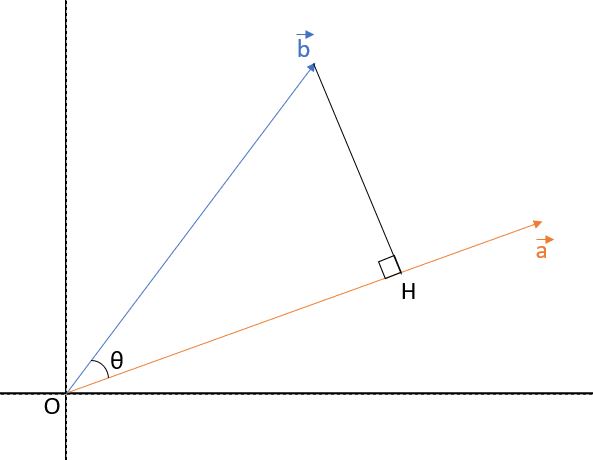
※ $ | \, \overrightarrow{b} \, | \, \cosθ˚ = | \, \overrightarrow{OH} \, |$ ⇒ $ \overrightarrow{a} \cdot \overrightarrow{b} = | \, \overrightarrow{a} \, | \, | \, \overrightarrow{b} \, | \, \cosθ˚ = |\, \overrightarrow{a} \, | \, | \, \overrightarrow{OH} \, | $
-평면벡터의 성분과 내적: 두 평면벡터 $ \overrightarrow{a}=(a_1, a_2), \, \overrightarrow{b}=(b_1, b_2)$에 대하여
: $ \overrightarrow{a} \cdot \overrightarrow{b} = a_1 b_1 + a_2 b_2 $
-평면벡터의 내적의 성질
①교환법칙: $ \overrightarrow{a} \cdot \overrightarrow{b} = \overrightarrow{b} \cdot \overrightarrow{a} $
②분배법칙: $ \overrightarrow{a} \cdot (\overrightarrow{b} + \overrightarrow{c}) = \overrightarrow{a} \cdot \overrightarrow{b} + \overrightarrow{a} \cdot \overrightarrow{c}, \, \, \, (\overrightarrow{a} + \overrightarrow{b}) \cdot \overrightarrow{c} = \overrightarrow{a} \cdot \overrightarrow{c} + \overrightarrow{b} \cdot \overrightarrow{c} $
③결합법칙: $(k \, \overrightarrow{a}) \cdot \overrightarrow{b} = \overrightarrow{a} \cdot (k \, \overrightarrow{b}) = k \, ( \overrightarrow{a} \cdot \overrightarrow{b})$
-평면벡터의 크기와 내적
① $ \overrightarrow{a} \cdot \overrightarrow{a} = | \, \overrightarrow{a} \, | \, | \, \overrightarrow{a} \, | \, \cos0˚ = | \, \overrightarrow{a} \, |^2 $
② $ | \, \overrightarrow{a} + \overrightarrow{b} \, |^2 = ( \overrightarrow{a} + \overrightarrow{b} ) \cdot ( \overrightarrow{a} + \overrightarrow{b} ) = ( \overrightarrow{a} \cdot \overrightarrow{a} )+( \overrightarrow{a} \cdot \overrightarrow{b})+ ( \overrightarrow{b} \cdot \overrightarrow{a})+( \overrightarrow{b} \cdot \overrightarrow{b}) = | \, \overrightarrow{a} \, |^2 + 2 \overrightarrow{a} \cdot \overrightarrow{b} + | \, \overrightarrow{b} \, |^2 $
③ $ | \, \overrightarrow{a} - \overrightarrow{b} \, |^2 = ( \overrightarrow{a} - \overrightarrow{b} ) \cdot ( \overrightarrow{a} - \overrightarrow{b} ) = ( \overrightarrow{a} \cdot \overrightarrow{a} )-( \overrightarrow{a} \cdot \overrightarrow{b})- ( \overrightarrow{b} \cdot \overrightarrow{a})+( \overrightarrow{b} \cdot \overrightarrow{b}) = | \, \overrightarrow{a} \, |^2 - 2 \overrightarrow{a} \cdot \overrightarrow{b} + | \, \overrightarrow{b} \, |^2 $
④ $ ( \overrightarrow{a} + \overrightarrow{b} ) \cdot ( \overrightarrow{a} - \overrightarrow{b} ) = | \, \overrightarrow{a} \, |^2 - | \, \overrightarrow{b} \, |^2 $
-두 평면벡터의 평행조건: $ \overrightarrow{a} \cdot \overrightarrow{b} = | \, \overrightarrow{a} \, | \, | \, \overrightarrow{b} \, | \, \cos0˚ \, \, \, \, \, = + | \, \overrightarrow{a} \, | \, | \, \overrightarrow{b} \, | = + \sqrt{{a_1}^2+{a_2}^2} \sqrt{{b_1}^2+{b_2}^2} $
: $ \overrightarrow{a} \cdot \overrightarrow{b} = | \, \overrightarrow{a} \, | \, | \, \overrightarrow{b} \, | \, \cos180˚ = - | \, \overrightarrow{a} \, | \, | \, \overrightarrow{b} \, | = - \sqrt{{a_1}^2+{a_2}^2} \sqrt{{b_1}^2+{b_2}^2} $
-두 평면벡터의 수직조건 : $ \overrightarrow{a} \cdot \overrightarrow{b} = | \, \overrightarrow{a} \, | \, | \, \overrightarrow{b} \, | \, \cos90˚ = a_1 b_1 + a_2 b_2 = 0 $
$(5)$직선의 방정식
-방향벡터: 점 $A$를 지나고 영벡터가 아닌 벡터 $ \overrightarrow{u} $에 평행한 직선 $l$위의 임의의 점을 $P$라 하고
두 점 $A, P$의 위치벡터를 각각 $ \overrightarrow{a}, \, \overrightarrow{p} $라 하면, $ \overrightarrow{p}= \overrightarrow{a} +t \overrightarrow{u} $
: 이때 벡터 $\overrightarrow{u}$를 직선 $l$의 방향벡터라 함
①점 $A(x_1, y_1)$을 지나고 방향벡터가 $ \overrightarrow{u}=(a, b)$인 직선의 방정식
: $\displaystyle {x-x_1 \over a}={y-y_1 \over b} \, (ab≠0)$
②두 점 $A(x_1, y_1), \, B(x_2, y_2)$를 지나는 직선의 방정식
: $\displaystyle {x-x_1 \over x_2-x_1}={y-y_1 \over y_2-y_1} \, (x_1≠x_2, \, y_1≠y_2)$
-법선벡터: 점 $A$를 지나고 영벡터가 아닌 벡터 $ \overrightarrow{n} $에 수직인 직선 $l$위의 임의의 점을 $P$라 하고
두 점 $A, P$의 위치벡터를 각각 $ \overrightarrow{a}, \, \overrightarrow{p} $라 하면, $ (\overrightarrow{p} - \overrightarrow{a}) \cdot \overrightarrow{n} = 0 $
: 이때 벡터 $\overrightarrow{n}$를 직선 $l$의 법선벡터라 함
①점 $A(x_1, y_1)$을 지나고 법선벡터가 $ \overrightarrow{n}=(a, b)$인 직선의 방정식
: $a(x-x_1)+b(y-y_1)=0$
$(6)$원의 방정식
중심이 $C(x_1, y_1)$이고 반지름의 길이가 $r$인 원 위의 임의의 점을 $P(x, y)$라 하고
두 점 $C, P$의 위치벡터를 각각 $ \overrightarrow{c}, \, \overrightarrow{p} $라 하면, $| \, \overrightarrow{CP} \, |^2 = | \, \overrightarrow{p} - \overrightarrow{c} \, |^2 = r^2$에서 $( \overrightarrow{p} - \overrightarrow{c} ) \cdot ( \overrightarrow{p} - \overrightarrow{c}) = r^2$
즉, $(x-x_1)^2 + (y-y_1)^2 = r^2$
'Study: 관심사 > 수학공식' 카테고리의 다른 글
| [2015 개정 교육과정]고3 확률과 통계 - Ⅰ. 경우의 수 (1) | 2025.08.02 |
|---|---|
| [2015 개정 교육과정]고3 기하 - Ⅲ. 공간도형과 공간좌표 (3) | 2025.07.29 |
| [2015 개정 교육과정]고3 기하 - Ⅰ. 이차곡선 (2) | 2025.07.18 |
| [2015 개정 교육과정]고3 미적분 - Ⅲ. 적분법 (2) | 2025.07.07 |
| [2015 개정 교육과정]고3 미적분 - Ⅱ. 미분법 (0) | 2025.07.04 |

댓글